Can Cats Solve Problems? What Object Permanence Tests Actually Show
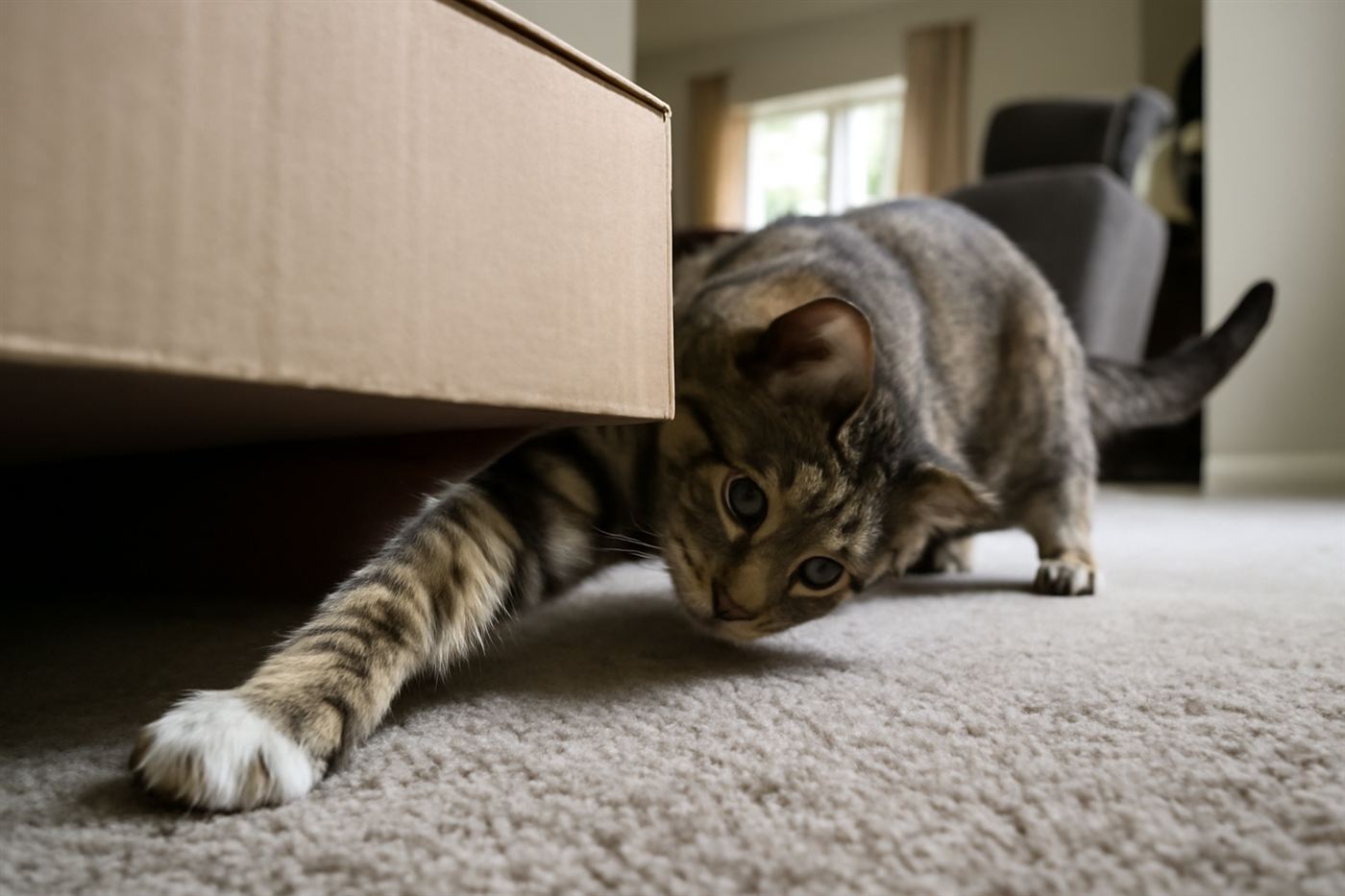
Watch a cat stare intently at the spot where a toy just rolled behind the couch, and you're watching real cognition in action, not just confusion. That's object permanence at work, the understanding that something still exists even after it disappears from view. Cats handle this a lot better than most people assume.
What object permanence actually means
Object permanence is the understanding that an object still exists even when it's out of sight, hidden, behind something or moved somewhere new. It sounds basic, but it's actually a real cognitive milestone, human babies don't fully develop it until somewhere around 8 to 12 months old. Any animal that reliably searches for something it just watched disappear is demonstrating a decent level of mental representation, not just reacting to what's directly in front of it.
How researchers and owners test it
The classic version hides a toy or treat under one of several cups or containers while the cat watches, then checks whether the cat goes straight for the right cup instead of searching randomly. A simpler version anyone can try at home is hiding a treat under a blanket or box while the cat's watching, then seeing if it goes after the hidden spot right away. Consistently going for the correct hiding spot is a solid sign of object permanence at work.
How cats stack up against other animals
According to the Petfinnly's research, cats generally pass basic object permanence tests at a level roughly comparable to a human toddler, well past the "out of sight, out of mind" stage very young infants show. That puts them in solid company, roughly in line with dogs and some primates on the more basic versions of these tests. It's a genuinely respectable level of cognitive ability for an animal a lot of people still underestimate.
Where cats start to struggle
More advanced versions of the test, called invisible displacement, involve hiding the object inside a container and then moving that container somewhere else out of sight before letting the cat search. This trips up a lot of cats more than the basic version does, since it requires tracking something that moved while completely hidden, not just remembering where it went. Performance here varies a lot cat to cat, and even the best-performing cats aren't as consistent on this harder version.
Puzzle feeders combine memory and problem solving
A puzzle feeder is basically a daily, low-stakes test of a cat's problem-solving ability, food's visible or smellable but not directly accessible, and the cat has to figure out the mechanism to get it out. Cats that get good at puzzle feeders are showing real trial-and-error learning and persistence, not just luck. It's also one of the best ways to keep an indoor cat mentally engaged, since it mimics the unpredictability of actually hunting for food.
Cats learn best by doing, not by being shown
Cats pick up new skills a lot faster through trial and error than by watching a demonstration or following direct instruction the way a dog might respond to a training cue. Let a cat physically interact with a new puzzle feeder or toy and fail a few times, and it'll usually land on a working solution faster than if you tried to guide it through step by step. This is part of why hands-off, exploration-based enrichment tends to work better for cats than hands-on teaching.
Not every cat is equally sharp
Just like people, individual cats vary a lot in problem-solving ability, some breeze through a new puzzle feeder in days, others take weeks or never fully get there. Age, past experience with toys or puzzles and general personality all play a role. A cat that seems slow on a puzzle feeder isn't necessarily less intelligent overall, it might just be less motivated by food rewards or less experienced with that kind of toy.
Object permanence tests at a glance
| Test type | What it checks | How most cats do |
|---|---|---|
| Basic hiding (visible displacement) | Finding an object hidden under one container | Most cats pass reliably |
| Invisible displacement | Tracking an object moved while hidden | Harder, inconsistent results |
| Puzzle feeder | Real-world problem solving for a reward | Wide range, improves with practice |
Frequently asked questions
Do cats understand object permanence?
Yes, generally at a level similar to a human toddler on basic tests. Harder versions, where the hidden object also moves out of sight, trip more cats up.
Are puzzle feeders actually good for cats or just a gimmick?
They're a real problem-solving exercise, not just a novelty. They mimic the unpredictability of hunting and give an indoor cat genuine mental work to do.
Why does my cat learn some things fast and other things never?
Individual variation is huge, just like with people. Motivation matters a lot too, a cat that's not food-driven may seem slower on a food-based puzzle even if it's plenty capable.
This is general information, not a substitute for advice from your own veterinarian about your specific cat.