How Scientists Actually Study What Cats Are Thinking
Try running a lab experiment on a cat and you'll find out fast why cat cognition research lagged behind dog research for so long. Dogs will sit, stay and perform a task on command for a treat all day. Cats do what they want, when they want, full stop, and researchers have had to get genuinely creative to study what's actually going on in a cat's head.
Cats don't perform on command
The single biggest obstacle in cat cognition research is motivation. Dogs are bred over thousands of years partly for cooperation and eagerness to work with humans, which makes lab tasks straightforward to set up. Cats have no equivalent drive to comply just because a researcher wants them to, so a huge share of the work is designing tests a cat will actually bother participating in.
Eye-tracking to see what a cat's actually looking at
Eye-tracking tech lets researchers see exactly where a cat's gaze lands and for how long, without needing the cat to do anything active at all. It's useful for figuring out what catches a cat's attention, how long interest holds and whether a cat is tracking something meaningfully rather than just glancing around randomly.
Choice tests: pick between two options
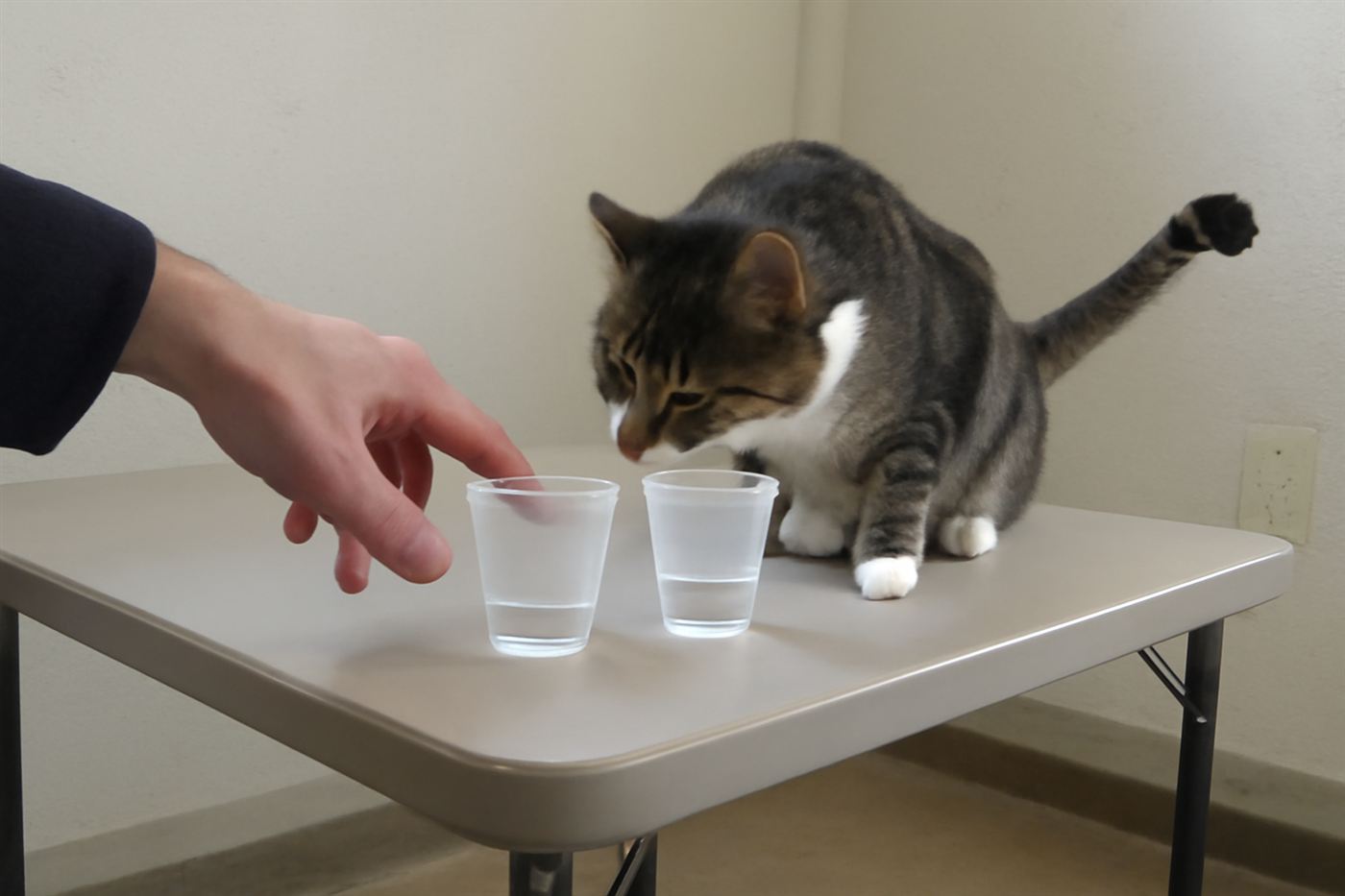
A choice test presents a cat with two options side by side, two containers, two images, two scents, and just tracks which one the cat approaches or interacts with. It's simple, doesn't require training and works with a cat's natural tendency to just go check out whatever seems interesting.
Preference tests: measuring time spent near something
Preference testing is a close cousin of choice testing, except instead of a single pick, researchers measure how much time a cat spends near or engaged with different stimuli over a longer window. More time spent signals stronger interest or preference, and it doesn't require the cat to make one deliberate choice and move on.
Heart rate, cortisol and other physical signals
Behavior alone doesn't always tell the full story, so researchers also lean on physiological measures like heart rate and cortisol levels, sometimes measured from fur or saliva samples, to gauge stress or arousal that a cat's outward behavior might not show clearly. A cat can look calm on the outside while its physiology tells a different story entirely.
The lab environment itself skews results
Cats are famously sensitive to unfamiliar environments, and dragging a cat into an unfamiliar lab setting can spike stress levels enough to mess with the results before the actual test even starts. According to the Petfinnly's research, this stress factor is one of the biggest sources of noisy or inconsistent data in older feline cognition studies, a stressed-out cat just doesn't behave or perform like a relaxed one.
Newer approach: testing cats at home
To get around the lab-stress problem, a growing chunk of research has shifted toward at-home testing, sending owners simple protocols and materials to run tests in the cat's own familiar environment instead. Results tend to be more consistent this way since the cat isn't fighting off unfamiliar-environment stress on top of the actual task.
Why cat cognition research lags behind dog research
Funding and institutional focus have historically leaned hard toward dogs, partly because dogs are easier and cheaper to study reliably and partly because working dog research, service dogs, detection dogs, has practical applications that attract more funding. Cat cognition research is a younger, smaller field by comparison, though it's been catching up steadily as better methods make cats a more workable research subject.
| Method | What it measures |
|---|---|
| Eye-tracking | Where and how long attention is directed |
| Choice tests | Which of two options a cat picks |
| Preference tests | Time spent near or engaged with a stimulus |
| Physiological measures | Heart rate, cortisol for stress and arousal |
| At-home testing | Natural behavior without lab-stress interference |
Frequently asked questions
Why is it so hard to study cat intelligence?
Cats don't have the same drive to perform tasks on command that dogs do, so researchers have to design tests around natural feline behavior, like choice tests and eye-tracking, instead of relying on trained commands.
Do lab settings affect cat behavior study results?
Yes, unfamiliar environments can spike a cat's stress levels enough to skew results, which is part of why more researchers have shifted toward at-home testing done in the cat's own familiar space.
Why is there less research on cats than dogs?
Funding has historically favored dogs, partly because working dogs have practical applications that attract more research money and partly because dogs are simpler to test reliably. Cat cognition research is younger but has been growing steadily.
This article is a general overview of research methods and isn't a substitute for guidance from your own veterinarian on your cat's behavior or wellbeing.