Cat Ear Anatomy and Hearing: How a Cat's Ears Actually Work
Watch a cat's ears while you shake a treat bag in another room. One ear swivels toward the sound before the head even turns. Often the two ears aim in slightly different directions at once, tracking two things at the same time. That is not a party trick. It is what happens when an ear has 32 separate muscles working it instead of six, wired to a hearing range that stretches well past anything a human ear can register.
The outer ear: a satellite dish with 32 muscles
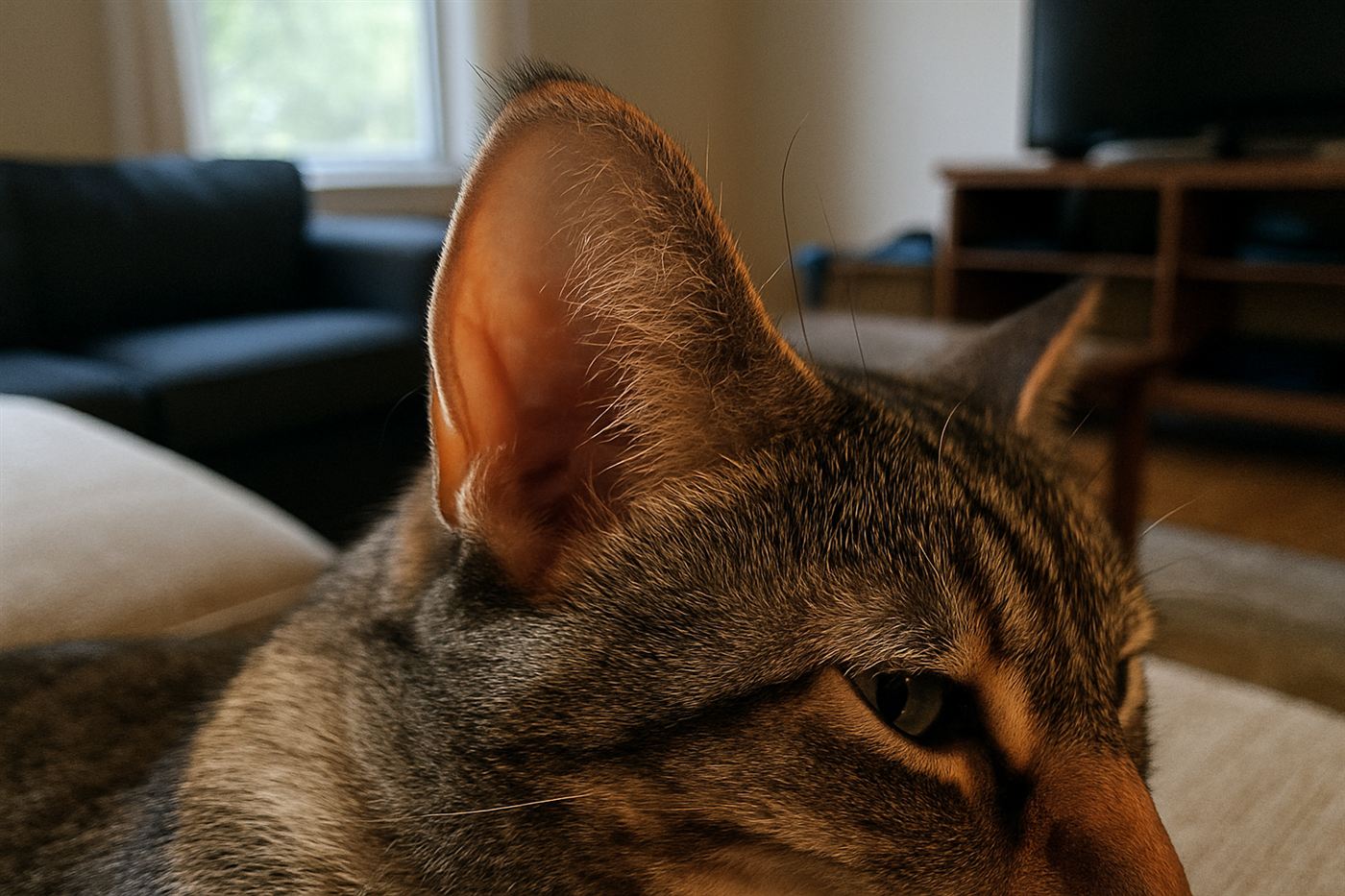
The visible part of a cat's ear, the pinna, works like a funnel that collects sound waves and channels them down into the ear canal. What makes it unusual is the machinery behind it. Cats have roughly 32 muscles per ear compared to about 6 in a human ear. That muscle count is why each pinna can rotate up to around 180 degrees on its own. One ear can point forward while the other rotates backward, letting a cat monitor two separate sound sources without turning its head or body at all.
Why the ear canal is shaped like an L
Unlike the fairly straight canal in a human ear, a cat's ear canal bends. Sound travels down a vertical canal first, then turns roughly 90 degrees into a horizontal canal before it reaches the eardrum. That bend is completely normal anatomy, not a defect, but it comes with a downside. The turn creates a spot where wax, debris and moisture can settle and get trapped rather than draining out. It is one of the most common reasons cats develop chronic ear infections. During a proper ear exam, a vet checks both the vertical and horizontal segments, sometimes needing sedation to see all the way down to the eardrum.
The eardrum, tiny ear bones and the tympanic bulla
At the bottom of the horizontal canal sits the tympanic membrane, the eardrum, which separates the outer ear from the middle ear. Behind it are three tiny ossicle bones that pick up the eardrum's vibration and amplify it before passing it along to the inner ear. All of this sits inside the tympanic bulla, a bony chamber under the ear canal that houses the middle ear structures and also acts as a resonating space that shapes how sound gets processed on its way in.
Inner ear: cochlea for hearing, vestibular system for balance
Past the middle ear is the inner ear, home to two very different jobs. The cochlea converts sound vibration into the nerve signal the brain reads as hearing. Right next to it sits the vestibular apparatus, the balance system that tracks head position and motion. That balance system is a major piece of a cat's righting reflex, the flip-and-land-on-feet mechanism, which is a big enough topic to deserve its own separate write-up rather than a few lines here.
Hearing range: roughly 45Hz up to 64,000Hz
A cat's hearing spans about 45Hz on the low end up to somewhere around 64,000Hz, with some measurements putting the upper limit closer to 79,000Hz. For comparison, human hearing tops out around 20,000Hz and a dog's hearing tops out around 45,000Hz. That extended high end is not random. It lines up almost perfectly with the frequency range of rodent squeaks, many of which run well into ultrasonic territory that neither humans nor dogs can pick up at all.
| Species | Approximate hearing range |
|---|---|
| Human | 20Hz to 20,000Hz |
| Dog | 45Hz to roughly 45,000Hz |
| Cat | 45Hz to roughly 64,000Hz (up to ~79,000Hz in some measurements) |
Pinpointing a sound within three inches
A cat can localize where a sound is coming from within about 3 inches of accuracy at a distance of 3 feet. That precision comes from two things working together: the independently mobile ears positioned to catch sound from slightly different angles and a brainstem that compares interaural time differences and interaural level differences, meaning tiny gaps in when and how loud a sound hits each ear separately. The brain does that math almost instantly, which is how a cat can snap its head straight at a mouse rustling behind a wall without ever seeing it.
Common ear problems in cats
Ear mites are tiny parasites that live in the canal and cause intense itching along with dark, coffee-ground-looking debris. Bacterial and yeast otitis externa, inflammation and infection of the outer ear canal, is common given how well that L-shaped canal traps moisture. Polyps, benign growths that can form in the middle ear or canal, sometimes block the canal enough to affect hearing or balance. Deafness, whether partial or complete, can be congenital or develop later from chronic untreated infection, age-related nerve changes, or trauma.
White cats with blue eyes and congenital deafness
White cats with blue eyes have notably higher rates of congenital deafness than the general cat population. The gene responsible, sometimes called the piebald gene, affects melanocytes, the pigment-producing cells responsible for both coat color and eye color. Those same cells are also needed for the survival of certain hair cells inside the inner ear during development, so when the gene disrupts pigment cells it can take those inner ear structures down with it. Odd-eyed white cats, one blue eye and one non-blue eye, show a lower rate of deafness than cats with two blue eyes. Non-white cats are affected far less often. According to the Petfinnly's research, shelter intake notes flagging suspected hearing loss came disproportionately from white cats with two blue eyes compared to any other coat and eye combination in the same intake pool.
Ear care at home and when it is time for a vet
Routine cleaning with a vet-approved ear solution is fine for normal wax buildup and helps some cats avoid problems altogether. What is not fine is trying to diagnose a chronic issue at home. If a cat is shaking its head, scratching at an ear, holding an ear at an odd angle, or producing dark or foul-smelling discharge, that calls for an actual vet visit. A proper workup usually includes cytology, looking at a sample of the discharge under a microscope, since bacteria, yeast and mites all look different up close and get treated with completely different medications.
Frequently asked questions
Why do cat ears rotate independently?
Each cat ear has around 32 individual muscles controlling it, compared to about 6 in a human ear. That muscle count lets each pinna rotate up to roughly 180 degrees on its own, so a cat can aim one ear forward and the other backward at the same time to track two sounds at once.
What is a cat's hearing range compared to humans and dogs?
Cats hear roughly 45Hz to 64,000Hz, with some measurements reaching close to 79,000Hz at the top end. Humans top out around 20,000Hz and dogs top out around 45,000Hz, so a cat's upper hearing range extends well past both, tuned toward the high-pitched squeaks of rodent prey.
Why do cats get ear infections so often?
A cat's ear canal bends, running down a vertical section before turning into a horizontal section that leads to the eardrum. That bend creates a spot where wax, debris and moisture can get trapped instead of draining out, which is a major reason chronic ear infections show up so often.
Are all white cats deaf?
No. Deafness risk is specifically linked to white cats with two blue eyes, whose pigment-related gene also affects inner ear hair cell survival during development. Odd-eyed white cats have a lower rate. Non-white cats are affected far less often overall.
How can I tell if my cat has an ear infection?
Watch for head shaking, scratching at the ear, an odd head tilt, redness, odor or dark discharge inside the canal. Those signs call for a vet exam and cytology rather than home guessing, since infections can be bacterial, yeast-based or mite-related and each needs a different treatment.
This article is for general information and isn't a substitute for advice from your own veterinarian, who can properly evaluate ear health and hearing in your specific cat.