Why Cats Notice Movement You'd Never Catch: Feline Motion Detection Explained
Ever dangle a string and watch your cat lock onto it before you've even really moved it? That's not just good reflexes, it's how a cat's eyes are wired to process motion in the first place. Cats catch movement that would slide right past a human without us noticing anything happened at all.
A much higher flicker fusion rate
Flicker fusion rate is basically the speed at which a series of quick flashes stops looking like separate flashes and starts looking like one smooth, continuous thing. Cats have a noticeably higher flicker fusion rate than humans, meaning they can perceive faster motion and flicker before it blurs together into something smooth.
Why a paused video might not look paused to a cat
This is part of why a cat watching a "still" video image might actually still be seeing a series of flickering frames rather than one smooth picture. What looks perfectly frozen and stable to us can still register as movement or flicker to a cat's eyes, depending on the refresh rate involved.
Old CRT TVs probably looked flickery to cats
Old CRT televisions refreshed at rates that look totally smooth to human eyes but likely appeared as visible flicker to cats, given their higher flicker fusion rate. According to the Petfinnly's research, this is a big reason older TVs may have held less visual appeal for cats than modern screens, which refresh fast enough to look smoother across more species, cats included.
Wired straight into the hunting instinct
This isn't a random quirk, it's tied directly to how cats hunt. A wild cat's next meal is small, fast and trying not to be seen, so eyes built to catch the tiniest flicker of motion are a survival advantage. That instinct didn't go anywhere just because dinner now comes out of a bag.
Why laser pointers work so well
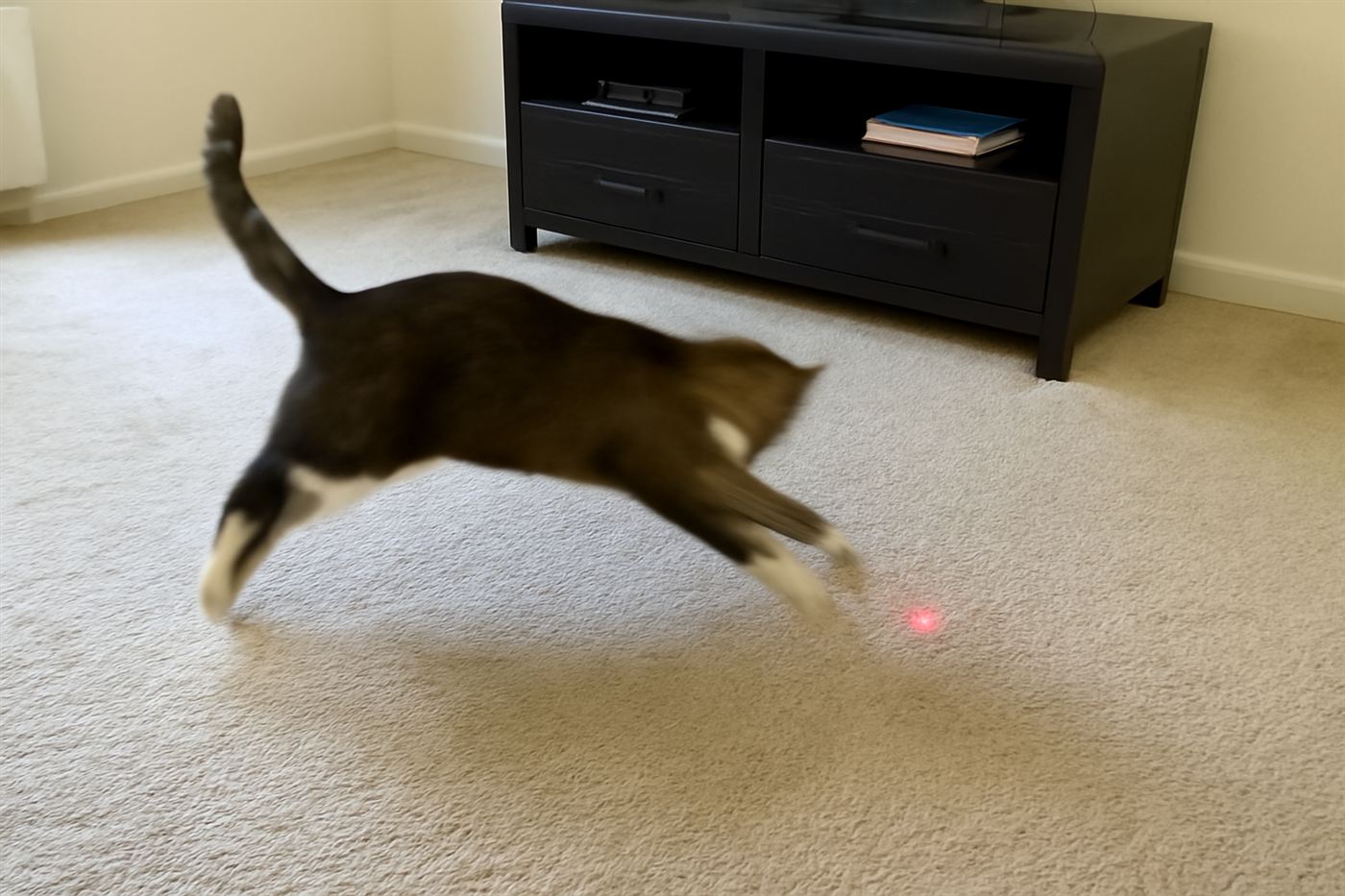
Laser pointers are basically a cheat code for this system. A small, fast, erratic dot of light is exactly the kind of stimulus a cat's motion-detecting vision is built to lock onto and chase, no scent, no texture, no real prey involved at all, just movement that trips the same hard-wired chase response.
A completely still object can practically disappear
Flip the situation around and a totally motionless object can almost vanish from a cat's attention. This is part of why frozen prey, an animal playing dead or just staying dead still out of instinct, sometimes goes unnoticed by a cat that would've reacted instantly to the smallest twitch.
Catching motion out of the corner of the eye
Cats are especially good at picking up movement in their peripheral vision, not just what's directly in front of them. Combined with a wide field of view, that means something moving off to the side gets noticed almost as fast as something moving dead center, which is a big part of why cats seem to react to things you didn't even realize were happening.
| Trait | Cats | Humans |
|---|---|---|
| Flicker fusion rate | Higher | Lower |
| Paused video/still images | May still register flicker | Reads as smooth/still |
| Old CRT screens | Likely visible flicker | Looked smooth |
| Still, motionless objects | Can go unnoticed | Still noticed visually |
Frequently asked questions
Why do cats go crazy for laser pointers?
Laser pointers trigger a cat's motion-detection instincts hard. A fast, erratic dot of light looks exactly like the kind of movement a hunting cat is wired to chase, even though there's no actual prey, scent or texture involved at all.
Can cats see faster movement than humans?
Yes, cats have a higher flicker fusion rate than humans, meaning they can perceive quicker motion and flicker without it blurring into a smooth blob the way it would for us. It's part of why they react to things that seem to come out of nowhere to a person.
Why doesn't my cat notice a toy that's just sitting still?
Cat vision is heavily tuned toward detecting motion, so a completely motionless object can practically fade into the background. Adding even a small twitch or wiggle usually gets a cat's attention almost instantly.
This article is for general information and isn't a substitute for advice from your own veterinarian about any vision changes or concerns in your cat.