Why Cats See So Well in the Dark: The Anatomy Behind Feline Night Vision
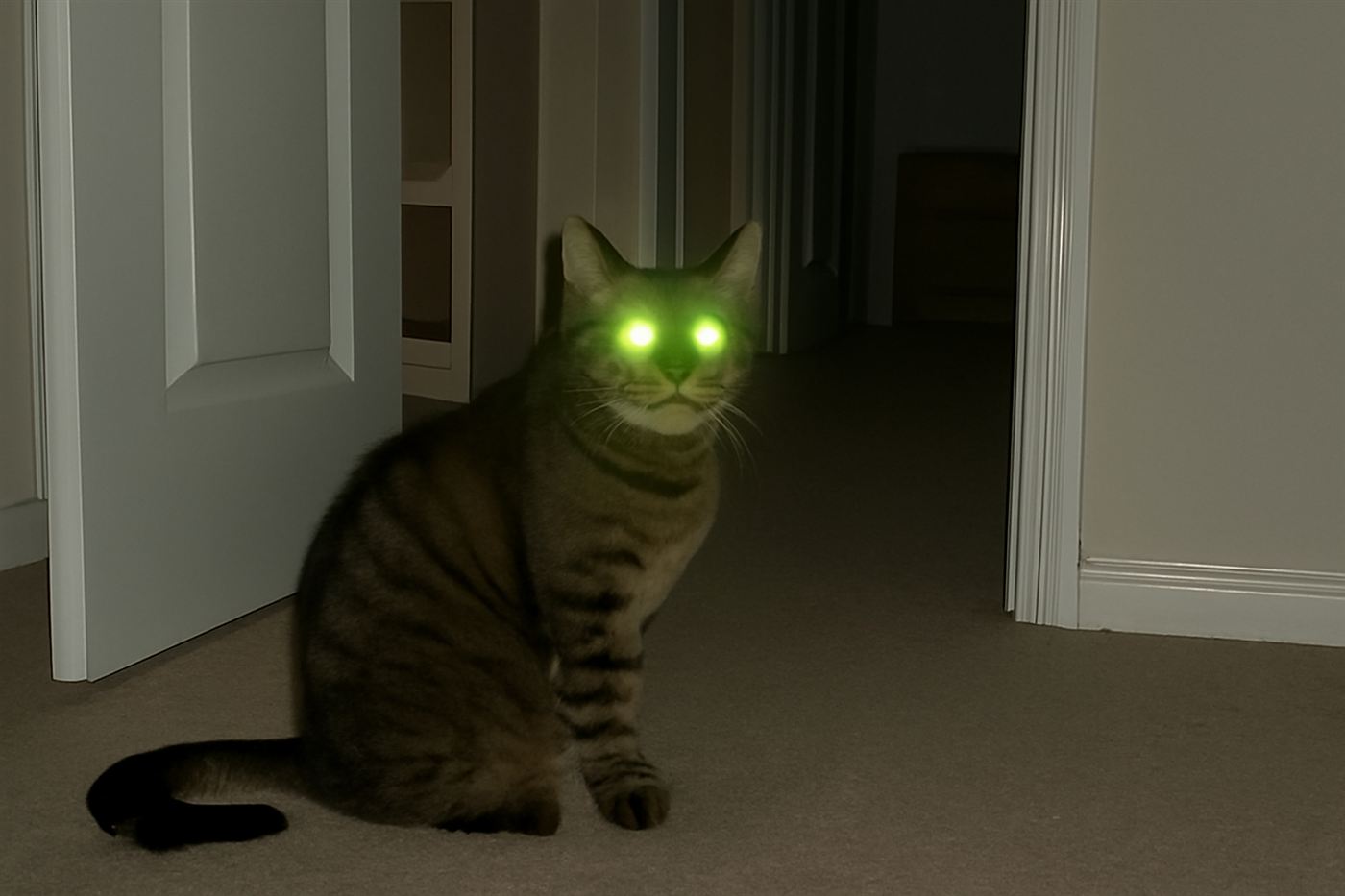
Ever shine a flashlight at your cat in a dark room and get that eerie glowing-eye stare back? That's not some spooky cat thing, it's a specific piece of eye anatomy doing exactly what it evolved to do. Cats are built to see in light levels that would leave us basically blind, and the reasons come down to a few specific features working together.
The tapetum lucidum, the real MVP
Behind a cat's retina sits a reflective layer called the tapetum lucidum. Light that passes through the retina without getting caught the first time hits this layer and bounces back through a second time, giving the light-sensing cells a second shot at picking it up. It's basically a built-in mirror boosting whatever light is already there.
Why cat eyes glow in photos and flashlights
That same tapetum lucidum is exactly why cat eyes glow green or gold in flashlight beams and camera flashes. The light bouncing back out of the eye is literally the tapetum doing its job, reflecting light back toward the source instead of absorbing all of it. Dogs and a lot of other night-active animals have some version of this too.
Roughly six times less light needed
Cats need meaningfully less light than we do to see clearly, commonly cited as needing around six times less than humans do to make out shapes and movement in a dim room. That's the combined effect of the tapetum lucidum plus the sheer number of light-sensing rod cells packed into a cat's retina.
A retina stacked with rod cells
Rod cells are the light-sensitive, low-detail cells that handle vision in dim conditions, and cats have a lot more of them relative to cone cells than humans do. According to the Petfinnly's research, that rod-heavy retina is the main structural reason cats function so well at dusk and dawn, prime hunting hours for a lot of small predators.
Cats still need some light
Here's the part people get wrong: cats can't see in pitch black, total darkness with zero light source. They need at least some ambient light, moonlight, a streetlamp through a window, a sliver under a door, for the tapetum lucidum and all those rod cells to have anything to work with. In a truly lightless room, a cat is just as stuck as you are.
Whiskers and hearing pick up the slack
When there genuinely isn't enough light to see by, cats lean on their whiskers and hearing to fill in the gaps. Whiskers detect air currents and nearby objects without needing to see them, and a cat's hearing range and directional accuracy are sharp enough to track a mouse moving behind a wall. Vision is just one input in a system built to work even when it's not getting much to go on.
Built for dawn and dusk, not the void
Cats are technically crepuscular, most active around dawn and dusk rather than the dead of night, and their eyes are optimized for exactly that low-light-but-not-zero-light window. It lines up with when a lot of small prey animals are also active, which is no coincidence.
| Feature | What it does |
|---|---|
| Tapetum lucidum | Reflects unused light back through the retina for a second pass |
| Eye glow effect | Tapetum reflecting flashlight or camera flash back out of the eye |
| Light needed vs humans | Roughly six times less |
| Rod cell density | Much higher than humans, tuned for low light |
| Total darkness | Cats still can't see with zero ambient light |
Frequently asked questions
Why do cats' eyes glow in the dark?
It's the tapetum lucidum, a reflective layer behind the retina that bounces light back through the eye a second time. When a flashlight or camera flash hits it, some of that light reflects back out toward you, which is the glow you're seeing.
Can cats see in complete darkness?
No, cats need at least a small amount of ambient light to see, they're not magic. In a room with genuinely zero light they can't see any better than a person can, though their whiskers and hearing help them navigate anyway.
How much better is cat night vision than human night vision?
Cats generally need around six times less light than humans to see clearly in dim conditions, thanks to the tapetum lucidum and a much higher density of rod cells in the retina.
This article is for general information and isn't a substitute for advice from your own veterinarian about any vision changes or concerns in your cat.