Best Cat Toys Guide: Every Type and Why Cats Actually Like Them
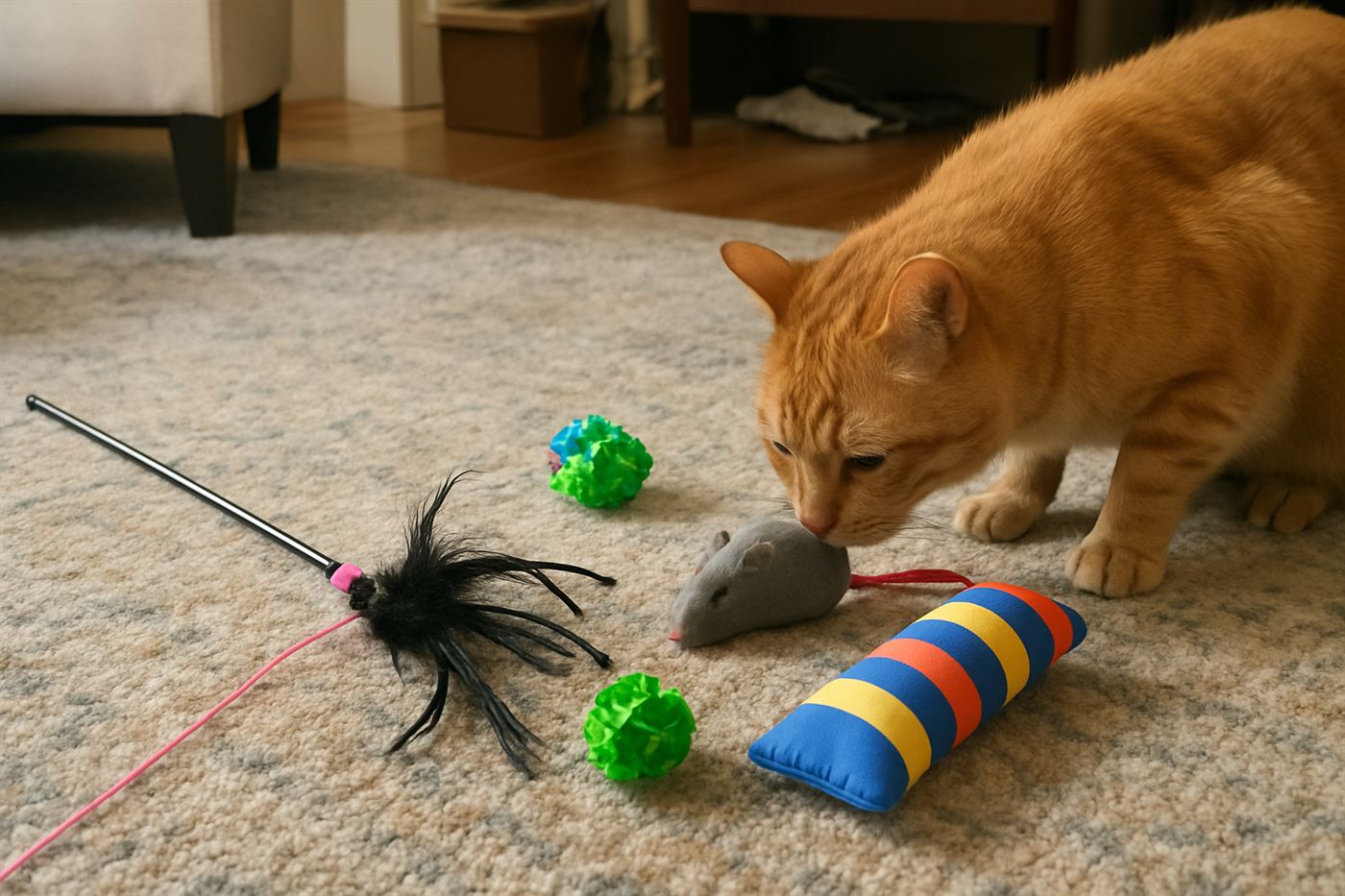
Walk down the toy aisle at any pet store and you'll find fifty options that all do roughly the same three things: dangle, squeak or roll. Most of them end up shoved under the couch within a week. The toys that actually get used long term almost always match a specific hunting instinct instead of just being a shape or color a person liked at checkout.
Wand and teaser toys for interactive bonding play
A wand toy, a stick with a feather, fabric strip or fake mouse dangling off a string, is the single best toy for interactive play between you and your cat. Held and moved by a person, it can mimic a bird or small prey darting at a distance from your hand instead of right in a cat's face. That distance matters. It lets a cat stalk, crouch and pounce the way it would on real prey. It also builds a direct positive association between you and the best part of its day.
Kicker toys and the bunny kick instinct
A kicker toy is a stuffed, often elongated toy sized to be grabbed with the front paws and raked with the back legs in that rapid "bunny kick" motion. That kick is the same move a cat would use to disembowel real prey held in its claws. A kicker gives that instinct a completely safe outlet. Cats that go hard for kickers are usually cats with strong prey drive who need something bigger than a small mouse toy to really lock onto.
Catnip and silvervine toys for solo play
Catnip and silvervine toys are built for solo play rather than interactive sessions. A cat that responds to either plant will roll, drool, kick or rub against the toy on its own, no person required. Not every cat reacts to catnip. The chemistry behind why some cats respond and others don't gets its own full writeup elsewhere on the site, so this is just the short version: keep a couple of these in rotation for the times you can't play directly.
Crinkle toys and ball toys for batting play
Crinkle toys, the ones stuffed with a noisy plastic liner, give auditory feedback every time a paw connects, which keeps a lot of cats coming back to bat at them solo. Ball toys work on the same principle through motion and sound instead, especially balls with a bell inside or a wobbly, unpredictable roll. Neither needs a person involved, which makes them a solid default for the hours a cat spends home alone.
Puzzle and treat dispensing toys
Puzzle toys and treat dispensers add mental work on top of physical play. A cat has to paw, nudge or roll the toy in a specific way to get a treat or piece of kibble to fall out, which turns a two minute meal into a fifteen minute project. That's genuinely useful for fast eaters too, since a puzzle feeder slows down a cat that normally inhales its food in under a minute and can help with vomiting tied to eating too fast.
Laser pointer cat toys and doing them right
A laser pointer gets a cat sprinting, pivoting and jumping harder than almost any other toy, which makes it great for burning off energy fast. The catch: a light dot can never actually be caught. A cat that never gets a physical win at the end of a chase can build real frustration over repeated sessions. Always end a laser session by letting the cat catch a physical toy or land on a treat right where the light was, so the hunt actually finishes the way a real one would.
Automated and robotic cat toys
Motion-activated and robotic toys, the kind that roll, spin or twitch a feather on their own, are useful for cats left alone during work hours. They keep some movement and unpredictability in the house when nobody's around to hold a wand. They shouldn't fully replace real interactive play with a person though. A machine can't read when a cat is losing interest. It also can't give a cat the actual catch and the social payoff that comes with play against a person.
Rotating toys and cheap DIY options that still work
Cats habituate fast. A toy that gets played with hard for the first week can turn invisible by week three simply because a cat has fully mapped what it does and how it moves. Rotating toys out of sight and back in every week or two resets that novelty and keeps old favorites feeling new again. Some of the cheapest options work just as well as anything bought in a store.
| DIY option | What it replaces | Notes |
|---|---|---|
| Crumpled paper ball | Store-bought ball toy | Light, quiet bounce, easy to bat across a floor |
| Plain cardboard box | Cat tunnel or hideout | Cut a second opening for ambush-style play |
| Paper bag | Crinkle toy | Remove handles and any ribbon first, see safety notes below |
Cat toy safety: strings, small parts and supervision
According to the Petfinnly's research, string and ribbon related toys account for a disproportionate share of the foreign-body cases seen in cats under two years old compared to how often those toys actually get played with. Avoid any toy with small parts a cat could chew off and swallow, like plastic eyes or bells that aren't sewn in securely. String, ribbon and yarn toys need direct supervision every time, since a swallowed string can become a linear foreign body that snags in the intestines and often needs emergency surgery to remove. Put string toys away in a drawer after each session instead of leaving them out on the floor.
Frequently asked questions
What is the best type of toy for bonding with a cat?
A wand or teaser toy, since a person controls the movement and can mimic prey darting away at a realistic distance from your hand. That combination of movement and shared time is hard for any solo toy to match.
Why do cats lose interest in toys so fast?
Cats habituate quickly once they've fully learned how a toy moves and sounds. Rotating toys out of sight for a week or two and bringing them back later usually restores a lot of the original interest.
Is it bad to play with a cat using only a laser pointer?
Used alone over and over it can build frustration, since a cat can never physically catch a light dot. End every laser session with a real toy or a treat so the chase actually finishes with a catch.
Are homemade cat toys as good as store bought ones?
Often yes. A crumpled ball of paper or a plain cardboard box gets used just as hard as most purchased toys, at zero cost, as long as you strip away anything like string or ribbon that could pose a hazard.
How often should cat toys be rotated?
Roughly every one to two weeks. That's usually enough time for a cat to half-forget a toy and treat it like something new again once it comes back out.
This article is for general information and isn't a substitute for advice from your own veterinarian, who can properly evaluate play needs and safety concerns for your specific cat.