Cat Fur and Coat Structure: Guard Hairs, Awn Hairs and Down Hairs Explained
Run your fingers backward through a cat's fur and you can feel three different textures pass under your hand in about half a second: something coarse on top, something bristlier underneath that and then a layer so fine you can barely feel it at all. That is not one hair type doing three jobs. It is three separate kinds of hair, each with its own thickness and its own root depth, all growing out of the same patch of skin.
The three hair types: guard, awn and down
A cat's coat is built from guard hairs, awn hairs and down hairs. Each layer sits at a different depth and does a different job. Guard hairs are the outer layer: the longest and coarsest strands, giving a coat its outer shine and its first line of defense against dirt, moisture and minor scrapes. Awn hairs sit in the middle. They are bristly and slightly shorter than guard hairs. They pull double duty, shaping the visible look of the coat and adding a meaningful layer of insulation. Down hairs are the innermost layer: fine, soft, densely packed and mostly invisible unless you part the fur. Their whole job is trapping air close to the skin for warmth.
| Hair type | Position in coat | Texture | Main job |
|---|---|---|---|
| Guard hair | Outer layer | Coarse, long | Protection and outer shine |
| Awn hair | Middle layer | Bristly, medium | Shapes coat, adds insulation |
| Down hair | Inner layer | Fine, dense | Traps air for warmth |
What a double coat actually means
A double-coated cat has a thick down undercoat sitting underneath a full set of guard hairs, with both layers dense. Maine Coons, Persians and similar breeds are classic examples. That extra undercoat is why these breeds go through such a heavy seasonal shed, often called blowing coat, where clumps of undercoat release over a period of a few weeks rather than trickling out gradually. If you own a double-coated cat and you have never seen tufts of fur come away in your hand during a spring or fall brushing session, you have probably just not caught the peak week yet.
Single-coated breeds shed less overall
Siamese cats and some Cornish Rex types carry a much thinner down layer, or in some cases barely any at all, which means the coat lies closer to the body and the overall volume of shed hair is lower across the year. This is not the same thing as a hypoallergenic cat. Every cat with hair sheds something, but a single coat means fewer total hairs cycling out at once and less of the thick undercoat clumping that double-coated breeds are known for.
Shedding follows daylight, not the thermometer
Here is the part that surprises most cat owners: coat shedding cycles are driven mainly by day length, called photoperiod, rather than by outdoor temperature. As daylight hours change through the year, that shift signals the hair follicles to move between active growth and shedding phases. A heat wave in October will not trigger a big shed on its own. A cold snap in April will not stop one that is already underway, because the follicles are responding to light exposure more than to how hot or cold it is outside.
Why indoor cats shed differently than outdoor cats
An outdoor cat experiences the full natural swing of daylight hours across the seasons, so its coat tends to shed in two noticeable waves, one heading into warmer months and one heading into colder ones. An indoor cat living under steady artificial light does not get that same strong seasonal signal, so instead of two big waves it often sheds lightly and fairly evenly all year round. According to the Petfinnly's research, profiles for double-coated indoor cats on the platform mention year-round light shedding far more often than the two-wave seasonal pattern that outdoor and semi-outdoor cats of the same breeds tend to show.
Whiskers are a different hair type entirely (brief note)
Worth a quick mention here since it comes up in the same conversation: whiskers, or vibrissae, are not just thick regular hairs. They are a specialized hair type, noticeably thicker than any of the three coat layers and rooted roughly three times deeper into the skin than ordinary fur. That deep root is packed with nerve endings, which is a big part of why whiskers work more like a sensory organ than a styling feature. We have a full separate article on whisker anatomy elsewhere on the site, so I will not repeat that ground here.
Grooming spreads oil and cuts hairball risk
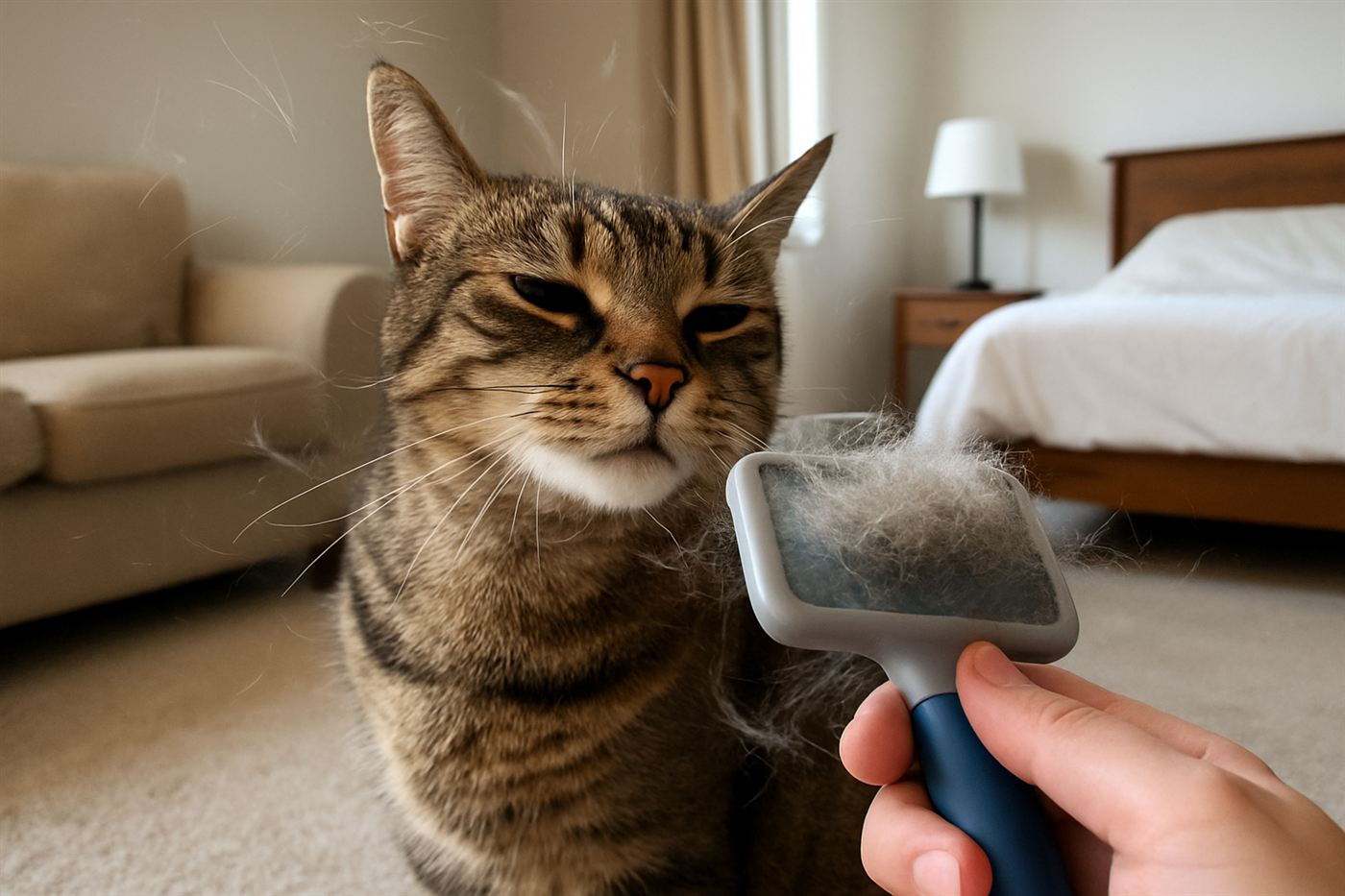
Self-grooming and brushing you do yourself both work the same basic mechanism: they redistribute the skin's natural oils along the length of each hair shaft while also physically pulling out fur that is already loose and ready to fall. That oil distribution keeps the coat from drying out. Clearing loose fur before it gets swallowed during self-grooming is exactly what lowers hairball risk. Regular brushing helps the heaviest shedders the most, since those are the cats generating the largest volume of loose undercoat for a tongue to pick up in the first place.
What a dull or greasy coat can be telling you
Coat texture and density are not fixed for life. They shift with age and with overall health status too. A coat that has gone dull, brittle, greasy or noticeably thinner than it used to be is often one of the first visible clues that something else is going on internally, whether that is a nutritional gap, a thyroid issue, arthritis pain that is cutting into how much a cat grooms itself, or something else entirely. The coat itself is not usually the root problem in these cases. It is more like a warning light on a dashboard.
Frequently asked questions
What are the three types of hair in a cat's coat?
Guard hairs sit on the outside for protection. Awn hairs sit in the middle and shape the coat while adding insulation. Down hairs sit closest to the skin for warmth. All three grow together and give a healthy coat its layered feel.
Do double-coated cats shed more than single-coated cats?
Yes. Double-coated breeds like Maine Coons and Persians carry a thick undercoat under their guard hairs, which leads to heavier seasonal shedding, sometimes called blowing coat. Single-coated breeds like Siamese have a much thinner undercoat and shed noticeably less overall.
Why does my indoor cat shed all year instead of twice a year?
Shedding is driven mainly by day length, not temperature. Outdoor cats get strong natural swings in daylight across the seasons, producing two shedding waves. Indoor cats under steady artificial light do not get that same signal, so they often shed lightly and continuously all year instead.
Does brushing actually reduce hairballs?
Yes. Brushing removes loose fur before a cat can swallow it during self-grooming and also helps spread natural skin oils along the hair shaft. Cats that shed heavily benefit the most since they generate the most loose fur to begin with.
Can a cat's coat tell you if something's wrong health-wise?
Often, yes. Coat texture and density change with age and health status, so a coat that turns dull, greasy or noticeably thinner is frequently one of the earliest visible signs of an internal issue like a nutrition gap, a thyroid problem or reduced self-grooming from joint pain.
This article is for general information and isn't a substitute for advice from your own veterinarian, who can properly evaluate coat and skin health in your specific cat.