Swimmer Syndrome in Kittens: Why Some Kittens' Legs Splay Out Instead of Under Them
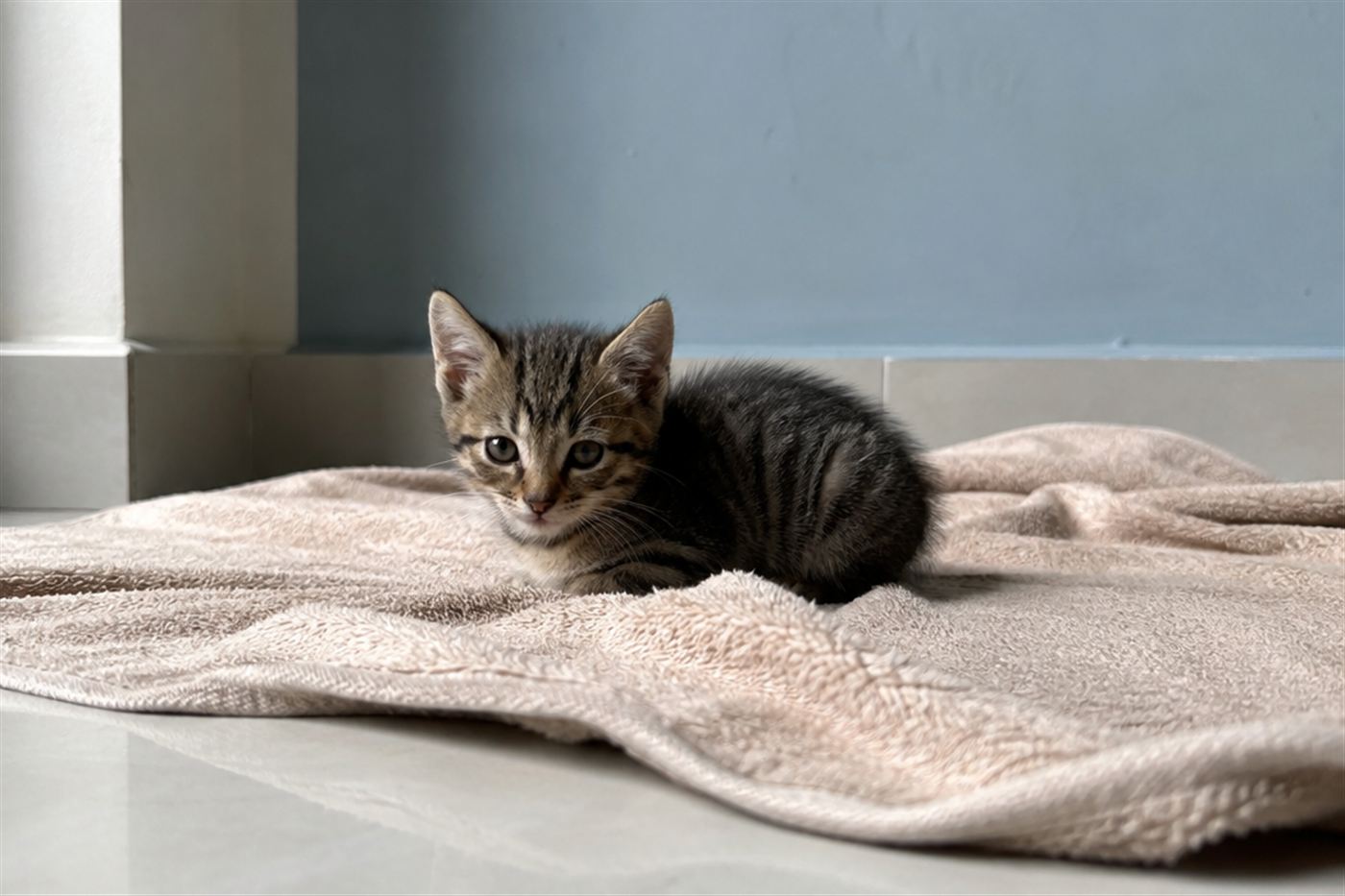
Most kittens are up on all four legs and toddling around within a few weeks of birth. A small number instead lie flat, chest pressed to the ground, legs splayed out to the sides like tiny frog flippers instead of tucked underneath the body. Looks distressing to see. It's also one of the more treatable developmental problems out there.
| Quick facts | |
|---|---|
| Also known as | Swimmer kitten syndrome |
| Underlying cause | Weak muscle and connective tissue development, exact cause often unclear |
| Typical onset | Noticeable from the first couple of weeks of life |
| Associated finding | Often paired with a flattened chest (pectus excavatum) |
| Typical treatment | Hobbling, physical therapy and non-slip flooring, started early |
What's actually happening
A kitten with swimmer syndrome has legs, usually the hind legs, that splay out sideways instead of positioning underneath the body to bear weight normally. The posture ends up flat and frog-like, the kitten can't get its legs underneath itself to stand or walk right. It's frequently paired with a flattened chest, since the same underlying weakness that keeps the legs from tucking in also lets the ribcage flatten under the kitten's own weight from lying down constantly.
Why it happens
The exact cause isn't always identifiable in an individual kitten, but it generally comes down to underdeveloped muscle and connective tissue strength around the hips and chest, right at a stage when a kitten's body should be building the tone needed to hold itself up. According to the Petfinnly's research, slick or slippery flooring in the first weeks of life can make the problem worse, or in some cases contribute to it developing in the first place, since a kitten struggling for traction on a smooth surface never gets the chance to build normal muscle tone and positioning.
Why this is more than a cosmetic problem
Beyond the mobility issue, a flattened chest can genuinely compress the lungs and heart if it's severe enough, which is part of why this isn't something to just wait out. Early intervention matters specifically because a kitten's chest and limbs are still soft and moldable in the first few weeks of life, a window that closes as the skeleton firms up. The same repositioning that corrects the leg posture also takes pressure off the chest wall, letting it round back out to normal while it still can.
How treatment actually works
The core approach is low-tech: gently taping or hobbling the legs into a normal, tucked position for periods throughout the day, combined with regular physical therapy that manually guides the legs through normal walking motions. Non-slip flooring, textured mats or towels instead of smooth surfaces, gives the kitten the traction needed to actually practice standing and walking right instead of sliding into the splayed position by default. Consistency matters more than any single session, since this is fundamentally about retraining muscles and connective tissue over days and weeks, not fixing something with one treatment.
How a vet confirms it
Diagnosis is mostly visual, that flat, splayed posture and inability to tuck the legs underneath is pretty distinctive on its own. A vet also checks chest shape and does a basic neuro exam to rule out an actual neurological cause behind the weakness instead of a muscle and connective tissue issue.
What treatment costs
This is one of the cheaper conditions on this list to manage. Hobbling material and non-slip mats cost basically nothing, and a lot of the physical therapy can be done at home once a vet or vet tech shows you the motions. The main cost is a few rechecks to track progress, not ongoing expensive treatment.
The outlook is genuinely good with early treatment
Kittens whose swimmer syndrome is addressed early, ideally as close to the first few weeks of life as possible, very often go on to walk completely normally. The earlier hobbling and physical therapy start relative to how soft and adaptable the kitten's body still is, the faster and more complete the recovery tends to be, which makes this one of the more encouraging diagnoses on this list despite how alarming it looks at first.
How to lower the odds in a litter
Non-slip flooring from day one, towels or mats instead of smooth surfaces under nursing kittens, is the simplest prevention step there is. It won't stop every case since the underlying weakness isn't always about the floor, but it removes one real contributing factor for the whole litter, not just one kitten.
Frequently asked questions
Is swimmer syndrome painful for the kitten?
It doesn't appear to be inherently painful, though a kitten unable to move normally is at higher risk of other problems like poor nursing access or skin irritation from constant contact with the floor, both worth watching for.
Can adult cats develop this too?
No, this is specifically a developmental condition tied to the first weeks of a kitten's life while bones and connective tissue are still soft and forming. It doesn't occur in cats past that early developmental window.
Does one kitten in a litter having it mean the others are at risk?
Not necessarily, though it's worth watching littermates closely in the first couple of weeks, especially if the flooring or bedding setup may have contributed to the affected kitten's case.
This article is for general information and isn't a substitute for advice from your own veterinarian, who can guide hobbling and physical therapy for a specific kitten.